

Shipping to the warehouse
Everything starts with getting your items to us. Share these instructions with your vendors and freight carriers - there is a printable copy in the portal made exactly for forwarding.
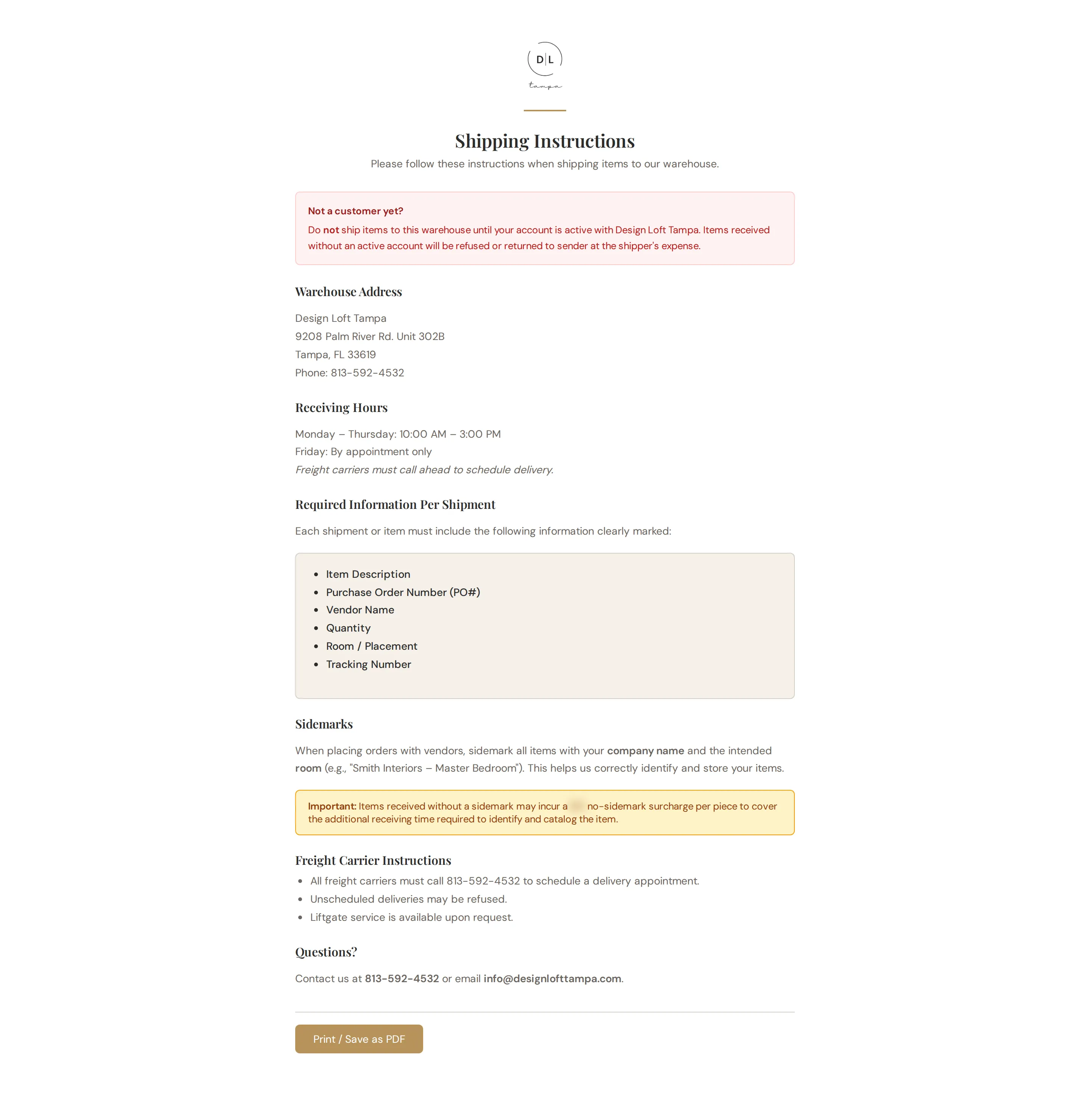
Where and when
Section titled “Where and when”Design Loft Tampa Receiving 9208 Palm River Rd. Unit 302B Tampa, FL 33619 813-592-4532
Receiving hours: Monday-Thursday 10am-3pm; Friday by appointment only.
Freight companies should call ahead to schedule delivery - please put our phone number on the BOL.
The sidemark rule (the most important one)
Section titled “The sidemark rule (the most important one)”Every box, crate, and pallet must carry a sidemark: your company name plus the project (and room, if you have it). The sidemark is how we match an arriving shipment to you the moment it hits the dock.
- With a sidemark: the item is checked in, inspected, photographed, and appears in your inventory under the right project.
- Without one: the item cannot be matched to you on arrival. Our office tries to work out whose it is, and if they cannot, it waits in Items to Claim until its owner claims it. A per-item handling surcharge applies for the extra work. The current amount is on the Rates page in your sidebar - see Rates.
When ordering, ask the vendor to include the sidemark on the shipping label - most trade vendors do this routinely.
What to tell us per shipment
Section titled “What to tell us per shipment”The portal’s shipping instructions list the details we like with every shipment - PO number, vendor, and piece count are the big ones. During onboarding you gave us your PO prefix and preferred vendors, which helps us match shipments even when paperwork is thin.
If nothing is shipping, ask us to go and get it. A showroom holding pieces for you, a job site that has to be cleared, a client’s garage - tell us where they are and we will send a truck and bring them in, and they are received here exactly like freight. See Pickups.
Better still, tell us directly on the portal’s Incoming Shipments page and we will watch for it. You can upload your order list as an Excel, CSV, or PDF file and have the whole project’s orders on our radar in one go, or report a single shipment as soon as a vendor confirms it shipped.
What happens when your items arrive
Section titled “What happens when your items arrive”- We receive the freight and check piece counts.
- Each item is unboxed, inspected, and photographed. Rugs are the one exception - see Rugs are shelved sealed.
- It goes on the racks and appears in your inventory, photos included - and you are notified.
- If we find damage - on the box at the dock, or on the piece itself once it is unwrapped and inspected - we open an issue for you right away, with close-up photos of what we found and, when several of the same piece are on one line, how many of them are affected.
Find the instructions any time: they are on your dashboard, and under Installs → Shipping Instructions with a Download button for forwarding to vendors.
Rugs are shelved sealed
Section titled “Rugs are shelved sealed”A rug arrives rolled and wrapped, and opening one means unrolling it, looking it over, then rolling and wrapping it again before it can go on the rack - handling that does a rug no favors. So rugs and rug pads are the one thing we do not open. We check the count against the paperwork, photograph and label the roll, and shelve it as it arrived. That is why a rug in your inventory shows the wrapped roll rather than the rug itself.
Rugs are also charged at a single receiving rate whatever their size - a runner and a 12 by 15 both count as one piece.
Want a rug opened and looked at? Just ask:
- Tell us before it gets to us - a note on the incoming shipment, an email, or a call. If that is how you want all your rugs handled, tell us once and we will note it for your account.
- We unwrap the rug at receiving, check the size, colorway, and condition, photograph it, and wrap it back up.
- If anything is wrong we open an issue with photos, the same as for any other piece.
Opening and inspecting a rug is different work from shelving it sealed, so it is charged at its own receiving rate in place of the standard rug rate, never on top of it. On your invoice that line reads Receiving Tier 2 (rug inspection) - see How receiving is charged. Both amounts sit side by side on the Rates page, so you can weigh one against the other before you ask.
What a shipment costs to receive
Section titled “What a shipment costs to receive”Receiving is charged per piece, and the rate comes from the box it arrived in: what is inside it, and how big and heavy it is. Nobody at our dock sets that by hand, so two boxes that are alike always cost the same to take in. A wooden crate or a pallet is charged once for the delivery on top of that, however much came on it. A box that is nothing but light bulbs is the one thing priced differently: one charge for the box plus a small amount per bulb, so a big lighting order does not bill like furniture. The full breakdown is in How receiving is charged.
You can price a shipment before you order it. The Rates page in your sidebar lists every receiving amount and the cubic feet and pounds that separate one tier from the next, so you can work out where a box will land from the vendor’s own dimensions - see Rates. Weight decides the top of that ladder on its own, so a dense piece like a stone or metal base can reach the heaviest rate in quite a small box.
Two things you control are worth knowing about. Boxes that arrive without a sidemark carry a per-item handling surcharge on top of receiving. And soft goods - linens, bedding, fabric, pillows, hardware - are received at the lightest rate when they come boxed together, so asking a vendor to ship them in their own box rather than padding out a furniture crate is money saved. Consolidating onto one pallet rather than two saves a pallet handling charge for the same reason.