

Your install estimate
Every install request shows an estimated cost, so you know roughly what a job will come to before you commit to it instead of finding out weeks later on an invoice.
You will see it in two places: while you are building the request, and on the request’s own page afterwards.
While you are picking the pieces
Section titled “While you are picking the pieces”- Open Installs → New Request (or Request Delivery from your inventory).
- Select the pieces for this trip under Items to Install.
- Estimated cost so far appears under the photo grid and updates as you go, so adding a piece shows you what that piece adds, right when you add it.
- Fill in the Delivery Address. The estimate sharpens once we know where we are driving, because the crew is on the clock for the drive out and back.
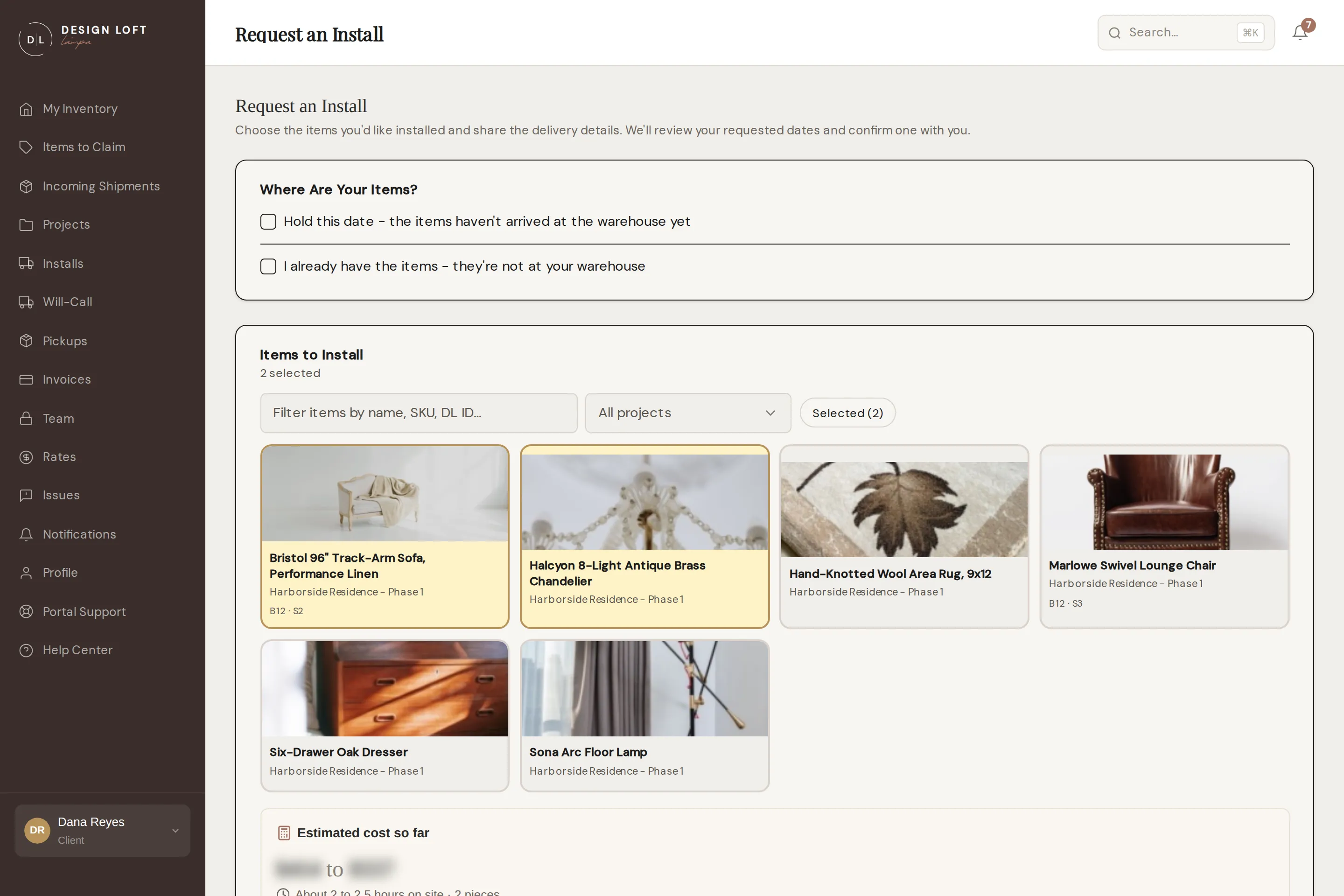
Nothing is committed while you are on the form. The estimate is there to help you decide what goes on this trip and what waits for the next one.
On the request’s page
Section titled “On the request’s page”Once your request is in, its page carries Estimated cost for this install near the top.
- Open Installs and click Details on the request.
- Read the range at the top of the card, and under it roughly how many hours on site to expect and how many pieces the estimate is based on.
- The small print under the range says what the number covers.
The estimate keeps up with the job. Add items, take items off, correct the address, and it is worked out again as soon as the change lands on the request - so the figure on the page always matches the job as it currently stands.
Why it is a range and not a price
Section titled “Why it is a range and not a price”An install is billed for the time our crew is actually on site. That is the honest way to charge for it, because two jobs with the same number of pieces can take very different amounts of time. A tight stairwell, a lift that has to be booked, a piece that has to come out of its carton and be walked round a corner - all of it is real time, and none of it is knowable from a list of items.
So the estimate is a band rather than a single figure. It is our best read of how the day is likely to go, not a fixed price, and the card says so.
What the estimate covers
Section titled “What the estimate covers”The estimate includes:
- Our crew’s time on site, based on how many pieces are going out and how long pieces like yours usually take, plus the time it takes to stage the van and walk the site before anything moves. A large job is estimated with a larger crew, which is charged at a higher hourly rate. This one drops out if your own install company is billing you for the crew - see If your install company bills you directly.
- The drive from our warehouse to your address and back, once you have filled in the address.
- Pulling your pieces from their shelves and getting them ready to load.
- The after-hours callout, if your install falls on a day the warehouse is normally closed - see Dates and closures.
The estimate does not include:
- Assembly. If a piece needs putting together, that is its own charge, billed by the hour. Tick Assembly required on the request and tell us what needs doing, and we will talk it through.
- Blanket wrapping, where a piece needs protecting for the trip.
- Anything your items already owe, such as receiving from when they arrived or their last month of storage. Those settle on the same invoice when your pieces leave us, which is what stops them trailing onto a separate statement later - see Your invoices.
That last one is the usual reason an install invoice is larger than the estimate: the invoice closes out your pieces completely, and the estimate only ever describes the install itself.
If your install company bills you directly
Section titled “If your install company bills you directly”A small number of clients arrange the install crew themselves and take a bid straight from the install company. If that is you, that company invoices you for the crew and we never see that bill.
Tell us as soon as you know. Once it is recorded on your request:
- The card is headed Estimated Design Loft charges for this install and the range covers our side of the job only: pulling your pieces off the shelves, getting them staged and loaded, and anything else we do that day.
- The drive out and back drops out of the range too. That time is part of the crew’s day, so it belongs on their bill rather than ours.
- The hours are still shown. The crew is on site for about that long whoever is billing for the day, and you may be planning around it.
- Your Design Loft invoice for the install carries no crew time at all. It is not shown as nothing, it is simply not on there, because it was never ours to bill.
- Everything else is unchanged. The warehouse pull, assembly or wrapping if we did either, a weekend callout if the day falls on one, and the settling up on any pieces that left us all appear exactly as they otherwise would.
A job like this is also invoiced sooner. An ordinary install waits on the install company’s bill before we can price it; here there is no bill coming to us, so the invoice can go out as soon as the job is closed out - see The invoice for your install.
The band will look small next to what an install usually estimates at, and that is the point: it is a fraction of a job rather than the whole of one. If we have not recorded it, the estimate on your request will still include crew time and will read much higher than what you will owe us. A quick message through Support is enough to put it right.
When there is no estimate
Section titled “When there is no estimate”- On a held date there are no items on the request yet, so there is nothing to cost. The estimate appears once you confirm your items.
- On an install of pieces you already have there is no item list at all, because none of it is in our warehouse. The estimate works from the pieces we are pulling, so a job like this carries none.
- On a request you placed before we added estimates, the card appears the next time anything on the request changes - an item added, or us confirming the date.
If you want a figure for a job in either state, ask us and we will work one out with you.
After the install
Section titled “After the install”Once the job is done, the estimate steps back to a single line on the request’s page: Estimated before the install, with the range we gave you. It stays there on purpose, so that when the invoice for the install appears on the same page a few days later, what we said beforehand is still next to what it came to.
The amount can land above or below the estimate. The common reasons:
- The day ran longer or shorter than expected. Access, parking, and how much moving around each piece needs are the biggest factors.
- The pieces changed. Items added to the request after it was booked, or pulled off it, change the work.
- Extras were needed on the day, such as assembly or wrapping.
If an invoice looks wrong to you, ask. Use Support in the portal and we will walk through it with you.
We check our own estimates
Section titled “We check our own estimates”We compare every estimate against what the job actually billed, and adjust how we estimate when we find we are consistently over or under. That is not something you have to chase us about; it is a standing part of how we run installs. It also means our estimates should get steadily closer over time, particularly for the kinds of job you send us most often.